- The Short Answer: Normal Vocabulary Sizes at 24 Months
- What Actually Counts as a "Word"?
- Beyond the Word Count: Key 2-Year-Old Speech Milestones
- Receptive vs. Expressive Language: Why Understanding Matters
- Red Flags: When to Consult a Pediatrician or Speech Therapist
- Practical Tips to Encourage Speech Development at Home
- Bilingual Toddlers and Word Counts
- Frequently Asked Questions
- Support Your Toddler's Speech Journey
The Short Answer: Normal Vocabulary Sizes at 24 Months
If you are closely watching your toddler’s development and wondering exactly how many words a 2-year-old should know, the direct answer is that a typical 24-month-old uses between 50 and 250 words. However, the most critical benchmark used by pediatricians and speech-language pathologists is the 50-word minimum. By their second birthday, children should ideally have an expressive vocabulary of at least 50 words and be beginning to combine two words together into simple phrases, such as “more milk” or “go outside.”
It is entirely normal for vocabulary sizes to vary wildly at this age. Some children might just be crossing the 50-word threshold, while others are chattering away with vocabularies closer to 300 words. For a broader look at age-based development, read our toddler development milestones guide. This period is often referred to as the “language explosion,” where toddlers suddenly begin acquiring new words on a daily basis. If your child is approaching their second birthday and has not yet reached the 50-word mark, it is highly recommended to consult with a pediatrician or early intervention specialist for a preliminary speech evaluation.

What Actually Counts as a “Word”?
Many parents unnecessarily worry about speech delays because they undercount their child’s vocabulary. It is a common misconception that a word only counts if it is pronounced perfectly and recognized in the adult dictionary. In the realm of early childhood speech development, a “word” is defined much more broadly. Any sound, syllable, or gesture that your toddler uses consistently and intentionally to mean the same thing counts as a word.
When tallying up your 2-year-old’s vocabulary, be sure to include the following categories, all of which represent valid, communicative milestones:
Animal Sounds
If your child consistently says “moo” when they see a cow, or “vroom” when playing with a toy car, these count as words. They are intentionally connecting a sound to a specific object.
Exclamations
Social exclamations and functional sounds like “uh-oh,” “yay,” “whee,” and “boom” are highly communicative and should be counted as part of their expressive vocabulary.
Word Approximations
Partial words count if used consistently. For example, if “ba” always means bottle, or “wawa” always means water, they are successfully communicating a specific concept.
Sign Language
Baby signs like “more,” “all done,” or “milk” count as words. Gestural communication requires the same cognitive mapping as spoken language.
Beyond the Word Count: Key 2-Year-Old Speech Milestones
While counting words is helpful, speech-language pathologists look at the broader picture of how a child uses language to communicate. A 24-month-old is transitioning from pointing and single words to actual conversational exchanges. Understanding both what they can say (expressive language) and what they can understand (receptive language) is crucial for a complete developmental assessment.
At two years old, one of the most significant milestones is the emergence of two-word combinations. Instead of just saying “milk,” they begin saying “want milk.” Instead of just “dog,” they might say “big dog.” These pairings show that the child is beginning to grasp elementary grammar and syntax.
Intelligibility is another major factor. At 24 months, a child’s speech should be roughly 50% intelligible to strangers. For official developmental guidance, parents can also review resources from the CDC developmental milestones. This means that a person who does not spend time with the child every day should be able to understand about half of what the toddler is saying. Family members will understand much more, but the 50% rule is a standard clinical benchmark for articulation.
Receptive vs. Expressive Language: Why Understanding Matters
Language development is a two-way street. Often, parents focus entirely on expressive language (what the child says) and overlook receptive language (what the child understands). In typical development, receptive language always outpaces expressive language. A 2-year-old who speaks 50 words likely understands well over 300 words.
If your child is a late talker but has excellent receptive language skills—meaning they can point to pictures in a book when you name them, follow simple instructions, and respond to their name—this is generally a very positive sign. Many late talkers with strong receptive skills eventually catch up to their peers without extensive intervention. However, if a child struggles with both speaking and understanding, it warrants a much more urgent evaluation by a professional.
Red Flags: When to Consult a Pediatrician or Speech Therapist
While toddlers develop at their own unique pace, there are specific warning signs that should prompt you to seek a professional opinion. Early intervention is incredibly effective, so it is always better to evaluate and find out everything is fine rather than adopt a “wait and see” approach that delays helpful therapies.
You should consult your pediatrician or schedule a speech-language pathology evaluation if your 24-month-old displays any of the following red flags:
- Fewer than 50 words: They have an expressive vocabulary of less than 50 spoken words, approximations, or signs.
- Not combining words: They are not yet linking two words together independently (excluding memorized phrases like “thank you”).
- Loss of skills: Any regression, such as losing words or social skills they previously mastered, requires immediate medical evaluation.
- Lack of gesturing: They do not point to objects of interest, wave goodbye, or use other non-verbal communication methods.
- Poor eye contact: They consistently avoid eye contact when communicating or being spoken to.
- Echolalia over spontaneous speech: They only echo or repeat what you say (or what they hear on television) rather than generating their own original words.
Practical Tips to Encourage Speech Development at Home
Parents are a child’s first and most important language teachers. You do not need expensive toys or flashcards to boost your toddler’s vocabulary. Simple play ideas and educational toys for toddlers can provide opportunities for language growth. Everyday routines present the best opportunities for natural language acquisition. Here are several evidence-based strategies you can use to encourage your two-year-old to talk:
- Narrate your day: Talk through your daily activities like a sportscaster. “I’m opening the fridge. I’m getting the cold milk. Pouring the milk into the blue cup.” This constant exposure to sentence structure builds their receptive language.
- Use the “expansion” technique: When your child says a single word, validate it and expand it into a phrase. If they point and say “Car,” you respond with, “Yes, a big red car!”
- Offer choices instead of yes/no questions: Instead of asking, “Do you want water?” (which prompts a nod or grunt), ask, “Do you want water or milk?” This requires them to retrieve and attempt to use the specific word.
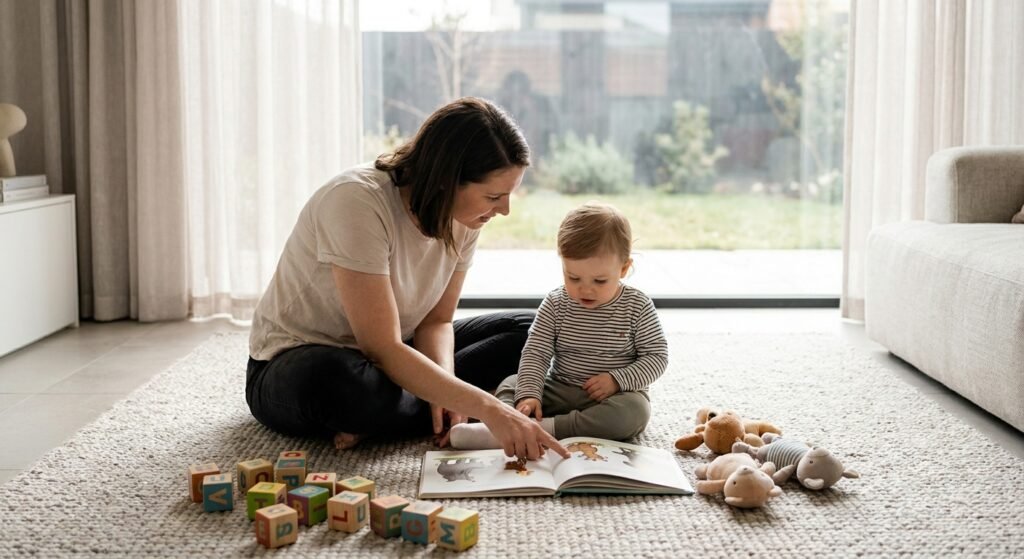
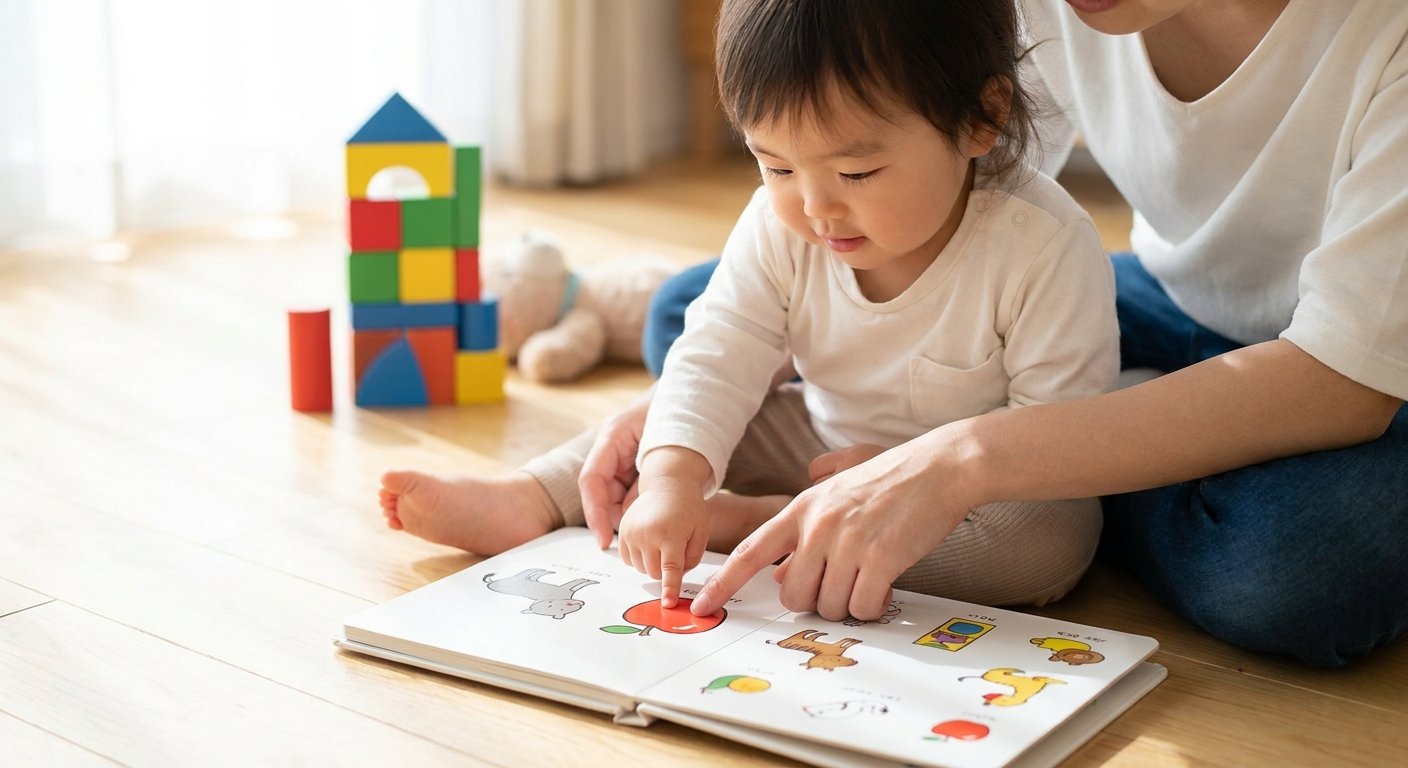
- Read interactively: Don’t just read the words on the page. Pause, point to pictures, and ask questions. “Where is the dog hiding?” Allow them time to process the question and point or speak before turning the page.
- Sing songs and nursery rhymes: The predictable rhythm and repetition in songs like “The Wheels on the Bus” or “Old MacDonald” are incredible tools for language learning. You can also explore more language learning games and educational tools to support your child’s development. Pause before the last word of a familiar line to let them fill in the blank.
- Limit background noise and screens: A television constantly running in the background makes it difficult for toddlers to isolate and focus on the human speech that is actually directed at them. High screen time is also strongly correlated with delayed expressive language skills.
Bilingual Toddlers and Word Counts
A common question among multicultural families is whether raising a child in a bilingual household causes speech delays. Decades of research show that bilingualism does not cause language delays. Bilingual toddlers achieve major milestones—like first words and two-word combinations—within the exact same timeframe as monolingual children.
However, when counting their words, you must combine the vocabularies of both languages. If your 24-month-old knows 30 words in English and 25 words in Spanish, their total vocabulary is 55 words. It is completely normal for them to mix languages in a single sentence (known as code-switching) as they navigate their dual-language environment.
Frequently Asked Questions
Do boys really talk later than girls?
Statistically, boys tend to produce their first words and reach the 50-word milestone slightly later than girls, often trailing by a month or two. However, this slight statistical difference does not change the clinical milestones. Both boys and girls should still reach the 50-word minimum by 24 months. Never ignore a potential delay simply because “he’s a boy.”
Are “late talkers” the same as autistic children?
Not at all. While delayed speech is one of the signs of autism spectrum disorder (ASD), the vast majority of late talkers are not autistic. An isolated speech delay simply means the child needs extra help with expressive language. A professional evaluation will look at other factors—like eye contact, joint attention, and sensory behaviors—to rule out or identify ASD.
Will daycare help my toddler talk more?
Socializing with peers can motivate toddlers to communicate, and daycare exposes them to new routines and vocabulary. However, relying solely on daycare is not a substitute for targeted speech therapy if a true delay exists. The most effective language growth happens through one-on-one interactions with responsive caregivers.
Support Your Toddler’s Speech Journey
Understanding how many words a 2-year-old should know is the first step in supporting their growth. If you are concerned about your child’s speech development, don’t wait to seek guidance from early intervention professionals.